AC diagnostics and repair
THE 17TH STREET AUTOMOTIVE VEHICLE A/C DIAGNOSTIC & REPAIR GUIDE
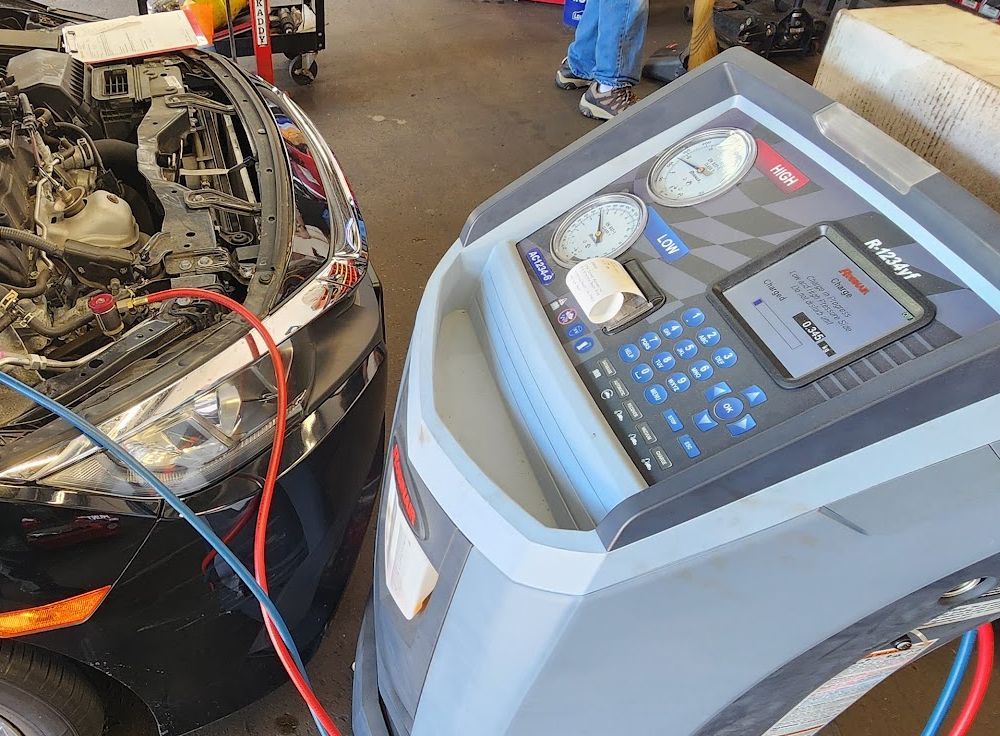
When the Virginia Beach summer heat hits, a malfunctioning vehicle air conditioning system transforms your daily commute into an oven. Understanding what is wrong with your A/C system helps us get you back on the road faster.
Below is our structured breakdown of the 5 most common A/C scenarios, the truth about modern refrigerants, and why cutting corners on A/C repair will always cost more in the long run.
SECTION 1: THE 4 MOST COMMON A/C SYMPTOMS
Scenario 1: The A/C is Cool, But Not Cold
- Typical Cause: Low refrigerant levels due to a slow, microscopic leak.
- The Reality: Automotive A/C systems are sealed, but over time, high-pressure vibrations can cause refrigerant to slowly permeate through rubber hoses and O-rings. If your air is slightly cool but fails to drop to a freezing temperature, it usually means the system lacks the pressure required to cycle efficiently.
Scenario 2: The A/C is Warm, Blows No Cold Air, or Fails Immediately After a Recharge
- Typical Cause: A large mechanical leak leading to complete system moisture penetration.
- The Reality: If your A/C works for only a day or two after adding refrigerant, you have a severe leak. When an A/C system sits empty or loses pressure rapidly, atmospheric air and moisture enter the system. Moisture is the ultimate enemy of an A/C system; when it mixes with refrigerant and oil, it creates a highly corrosive acid that destroys internal components, sludges the expansion valve, and ruins the compressor. This scenario typically requires a complete A/C system repair, not just a simple top-off.
Scenario 3: No Airflow Coming From Vents, Defrost, or Floor
- Typical Cause: Electrical failure or blower motor malfunction.
- The Reality: If the temperature controls feel right but absolutely no air physically blows out of your vents, the issue lies in the ventilation electrical system. Common culprits include a blown electrical fuse, a failed blower motor resistor (which controls fan speeds), a completely burned-out blower motor, or failed electronic blend door actuators inside the dashboard.
Scenario 4: Broken Belts, Seized Pulleys, or Inoperative Compressors
- Typical Cause: Component mechanical failure or electronic clutch breakdown.
- The Reality: Your A/C compressor requires mechanical or electrical power to pump refrigerant.
- Gas/Diesel Vehicles: A seized compressor pulley or bad idler bearing can throw off your vehicle's serpentine/accessory belt entirely, leaving you stranded without power steering or an alternator.
- Hybrid & Electric Vehicles (EVs): These use highly advanced, high-voltage electric A/C compressors. If the compressor or its electronic control module fails internally, the system goes entirely inoperative and requires specialized diagnostic tools to safely service.
SECTION 2: THE ULTIMATE REFRIGERANT COMPARISON
Pros & Cons Environmental & Regulatory Concerns Cost Factor
Automotive cooling technology has evolved heavily to protect the environment. Never mix different types of refrigerant. Doing so will permanently contaminate your vehicle's system and destroy professional shop machinery.
Refrigerant Type Vehicles Used In Pre-1994 Vehicles
R12 (Freon) Old Classic Vehicles PRE OBD2 Vehicles
Pros: Extremely efficient cooling.
Cons: Outdated, heavily restricted.
High Damage: Contains CFCs that severely deplete the ozone layer. Completely banned from production. Requires a full retrofit to R134a. Extremely Expensive / Unavailable
R134a 1994 – 2013+ Vehicles
Pros: Reliable, widely adopted for decades.
Cons: Being systematically phased out on newer models.
Moderate Damage: Does not hurt the ozone layer, but has a very high Global Warming Potential (GWP).
Moderately Priced
R1234yf Most Vehicles Post-2014+
Pros: Incredibly eco-friendly.
Cons: Mildly flammable; requires highly specialized, closed-loop shop equipment to service safely.
Eco-Friendly: Breaks down in the atmosphere in just days. Has a near-zero GWP. Legally mandated for newer fleets.
Highly Expensive
⚠️ Regulatory Note: To legally purchase, handle, or service any of these refrigerants commercially, technicians must hold an EPA Section 609 Certification. Our team at 17th Street Automotive is fully certified and equipped to handle all three generations of automotive climate control systems.
SECTION 3: THE HAZARDS OF DIY & THE DANGERS OF "STOP LEAK"
It is incredibly tempting to grab a cheap "recharge kit" from a local auto parts store. However, this is one of the most expensive mistakes a vehicle owner can make.
*****important: Why You Must NEVER Use "Stop Leak" Products*****
Chemical "A/C Stop Leak" products work by reacting with moisture and air to form a chemical seal or hardened epoxy patch.
- Inside Your Vehicle: Because a leaking system already has moisture inside it, the stop leak chemical activates inside your lines, turning into a sticky sludge or hardened resin. It instantly plugs up the microscopic screens in your expansion valve, glues your compressor valves shut, and ruins your condenser.
- The Backyard Mechanic Tax: If a DIYer or uncertified backyard shop puts stop leak or contaminated gas into a vehicle, a professional shop cannot hook up their standard machine to it without ruining their $10,000+ equipment. Undoing a contaminated system requires replacing almost every single component of your A/C system, turning a minor repair into a multi-thousand-dollar bill.
Our Machine Protection Protocol
At 17th Street Automotive, we utilize an advanced Refrigerant Identifier AND AC refrigerant FILTERATION before connecting your vehicle to our state-of-the-art recovery machines. This tool samples the gas inside your system to verify its purity. If it detects stop leak, air contamination, or illegal flammable gases (like propane mixtures used in cheap off-brand kits), we isolate the vehicle to prevent catastrophic destruction of our shop equipment.
SECTION 4: 17TH STREET AUTOMOTIVE DIAGNOSTIC PROTOCOL
We don't guess; we measure. To fix your A/C correctly the first time, our ASE-certified technicians perform a rigorous multi-step diagnostic process:
[System Inspection & Identification] ➔ [Refrigerant Evacuation] ➔ [Deep Vacuum Test] ➔ [Dye Installation & Leak Tracing] ➔ [Precision Recharge]
- The Deep Vacuum Test: We hook your system up to a specialized vacuum pump to extract all air and moisture. Pulling a deep vacuum lowers the boiling point of any residual water trapped inside, forcing it to evaporate away completely. If the system cannot hold a perfect vacuum for a specified duration, it tells our machines that an external leak is present before we waste your money injecting new refrigerant.
- UV Dye Installation: We inject a specialized ultraviolet (UV) fluorescent dye into the system along with exact amounts of clean compressor lubricating oil. If a slow or hidden leak exists deep within your dashboard (like a failing evaporator core), our technicians can pinpoint the exact origin using specialized UV lights and yellow enhancement glasses.
- Precision Evacuate & Recharge: A/C systems do not operate within a generic range; they require a highly precise weight of refrigerant measured down to the exact ounce. Our digital machines calculate the perfect factory specification charge, ensuring your system runs optimally without over-pressurizing or under-performing.
Ready for True Climate Comfort?
If your A/C is giving you trouble, leave it to the certified professionals. Don't risk turning a simple fix into a total system replacement.
Book Your A/C Service Appointment Online or call the crew at (757) 425-8917 today!